Slavery
The Ownership Wars: Who Owns YouSlavery is treated as both a concrete historical institution and the governing image of the book’s critique of capitalism. In its historical form, it is the legally enforced ownership of human beings; in its modern extension, it becomes the condition of people without capital who must submit their labor and security to those who control property, inheritance, corporations, and political power. The book’s decisive claim is that emancipation requires more than ending formal ownership: it requires dismantling the economic and ideological structures that make dependence appear voluntary, natural, or deserved.
Historical Slavery and Class Power
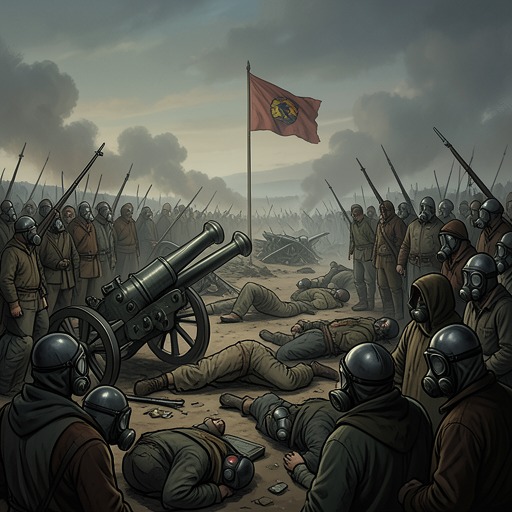
Slavery appears first as the foundation of the Confederacy’s social order and as a mechanism that enriched a small Southern elite while harming white workers as well as enslaved Black people. The book describes the Confederacy as a con job organized for the benefit of wealthy slaveholders and imposed upon the Southern white working class. Because enslaved Black laborers were forced to work without pay, wages were driven down for other workers. The effect extended beyond agriculture: approximately a quarter of enslaved Black people worked in construction, manufacturing, and lumbering, depressing wages even for skilled white laborers.
The resulting wealth was concentrated rather than shared. Slavery helped make Southern states the richest in the country, while most Southern whites saw little of the wealth produced in plantation society. Low wages, few schools, limited land ownership, and low literacy left them materially insecure. They nevertheless were persuaded to risk their lives for a system from which they received only a thin portion of the economic gains. The book argues that racial hierarchy made those meager rewards psychologically acceptable: many whites could take satisfaction from knowing that enslaved Black people received no share at all.
This arrangement is presented as a durable political technology. The white working class was encouraged to defend the property and profits of the elite by identifying downward rather than upward. The result was a class alliance in which racial exclusion substituted for economic power. The book uses this history to interpret later conservative politics, arguing that resentment and racial privilege can persuade subordinated groups to protect the institutions that subordinate them.
Slavery and Capitalism
The book states its modern thesis directly: capitalism is slavery because those without capital are made dependent upon those with capital. In this account, the absence of capital is not a temporary disadvantage that anyone can easily overcome. Inheritance, privilege, nepotism, cronyism, and private power reproduce ownership across generations, allowing the capitalist elite to preserve control while presenting the resulting hierarchy as competition or merit.
The historical comparison rests on the treatment of labor as a cost to be minimized. The Confederacy’s defenders regarded enslaved people as private property and opposed state intervention that would deprive owners of that property. The book interprets the Civil War as a conflict over the acceptable limits of capitalist behavior: whether profit could justify the ownership of human beings, and whether government had the authority to prevent private wealth from converting people into instruments of accumulation.
That interpretation extends from chattel slavery to wage labor. The book calls the employee a capitalist euphemism for the slave and casts employers as masters, owners, and slavers. The analogy is not offered as a description of identical legal conditions; it is used to emphasize the relation of command and dependence. A person who lacks capital must sell labor under conditions set by those who own productive resources, while the owner retains the power to determine access to livelihood.
The argument also identifies a contradiction in the right-wing defense of property. The Confederacy claimed that government was tyrannical because it threatened slave property, even though the slaveholders themselves had subjected other human beings to coercion. The book therefore presents the so-called Non-aggression principle as morally inverted when property includes persons. In its polemical formulation, a system with no effective regulation or government control can protect the right of capitalists to enslave, exploit, and mutilate others rather than secure freedom.
Modern Political Repetition
The book repeatedly maps the Confederacy onto contemporary right-wing politics. It describes the Trump insurgency as a sequel to the Confederacy: a return to far-right conservative rule founded on racism, white supremacy, and ultra-plutocracy. It also compares that politics to the world imagined in Ayn Rand’s Atlas Shrugged, treating both as visions in which wealth and ownership become the decisive measures of social authority.
Donald Trump is used as an emblem of hereditary class power rather than as an outsider to the elite. The book reports that he inherited approximately $300 million from his father and that the National Journal described him as beginning with $40 million in 1974, when he became president of his father’s real-estate company. These details are used to challenge the image of self-made success and to argue that inherited wealth permits even a person who repeatedly fails in business to remain financially powerful. The proposed remedy is a 100 percent inheritance tax, which the book claims would have prevented the continued reproduction of dynastic wealth and spared the country Donald Trump’s political ascent.
The same structure is applied to Trump’s supporters. The book argues that many people who claim to oppose the elite instead place one of the one percent in the White House, mistaking the elevation of a billionaire plutocrat for a revolutionary attack on plutocracy. Their political behavior is described as a form of false consciousness: they defend the class that owns the system while imagining themselves to be fighting it. The slavery metaphor therefore includes not only economic compulsion but also the active political support of one’s own subordination.
The book broadens the class analysis through its discussion of the middle class. It presents early predatory capitalism as a system in which the great majority hated the Ownership Class, then argues that the elite created a middle class whose members aspired to join the ruling order and served as its managers, agents, gatekeepers, and enforcers. This intermediary position complicates the simple opposition between one percent and ninety-nine percent. As many as a quarter of the nominal ninety-nine percent are described as class collaborators who defend elite interests, particularly through support for conservative parties.
Ideology, Consent, and Hidden Control
Slavery is sustained in the book not only by force but by the manufacture of consent. The concept of cultural hegemony explains how the dominant class imposes its worldview until policies harmful to subordinate groups are accepted as common sense. Oppression becomes most stable when the oppressed adopt the assumptions of their oppressors and regard alternatives as irrational, dangerous, or impossible.
George Carlin’s critique of political ownership supplies a related vocabulary. Politicians are portrayed as giving citizens the appearance of choice while the real owners control land, corporations, legislatures, courts, and major media. Those owners want obedient workers: people capable of operating machines and completing paperwork but not of sustained critical thought about falling pay, longer hours, reduced benefits, disappearing overtime, vanishing pensions, and threats to Social Security. The image is of a population trained for compliance and deprived of the intellectual conditions needed to recognize its own exploitation.
The book connects this ideological slavery to advertising and unconscious desire. In the account of Century of the Self, capitalism adopts Sigmund Freud’s theory of the unconscious, while Edward Bernays applies psychological manipulation to commerce and public opinion. Advertising does not merely present goods; it targets desire in order to maximize profit for the Ownership Class. Consumers are thus governed through wants that feel private even when they have been systematically cultivated.
The film They Live becomes a cultural allegory for the same process. Its hidden signal creates false consciousness, conceals the ruling elite’s true identity, and prevents the working class from seeing the system that has brought about economic collapse and near-enslavement. The Resistance seeks to hack the signal and awaken the population. The book emphasizes that John Carpenter understood the aliens as yuppie followers of Ronald Reagan and as symbols of unrestrained capitalism, not as a justification for antisemitic conspiracy theories. The special sunglasses, later analyzed by Slavoj Žižek as a critique of ideology, reveal the dictatorship beneath the appearance of democratic freedom.
Taxation, Institutions, and Liberation
The contemporary form of slavery is also located in institutions that distribute obligations unequally. The book describes two tax systems: one designed for corporations and the super-rich, who can employ expensive lawyers and accountants, and another imposed upon ordinary people, who face a complex and punitive system without comparable assistance. A proposed “virtual corporation” would allow ordinary taxpayers to pool resources and obtain professional tax support, preventing them from being isolated and intimidated one by one.
The principle is institutional equality rather than special treatment. Corporations should receive the same treatment as ordinary people, or ordinary people should receive the protections and opportunities available to corporations. The book condemns a system in which one law applies to the strong and another, more punitive law applies to the weak. It also argues that the near absence of television programs about financial scandals, compared with the abundance of murder programs, reflects the elite’s unwillingness to illuminate taxation, banking, and the special deals available to corporations and the wealthy.
Automatic taxation is offered as an alternative to concealment and evasion. If every payment entering a bank account were taxed automatically, tax returns could be eliminated, and money laundering, offshore concealment, avoidance, and evasion would become impossible. The book applies this demand directly to Donald Trump, arguing that a president should not be permitted to withhold tax affairs from the people subject to presidential authority.
The proposed political answer is positive state action. Abraham Lincoln is presented as the president most associated with positive liberty because he recognized the wrongness of slavery and used the state to defeat the Confederacy despite the inevitability of civil war. The book calls for a new Lincoln to defeat the Confederacy not only as a physical historical entity but as a mental and ideological one: the doctrine of unrestrained predatory capitalism that turns people without capital into slaves.
The conclusion returns to the master–slave dialectic as the condition that must end. The Ownership Class is said to own ordinary people “lock, stock and barrel,” making them slaves in the economic and political sense developed throughout the book. Freedom therefore means overthrowing the Ownership Class and preventing its return, rather than merely changing officeholders or expanding the appearance of consumer and electoral choice. Slavery remains the book’s final measure of injustice: wherever ownership gives one class command over the livelihood, labor, and consciousness of another, emancipation is incomplete.